





Each period of DataRobot has shipped open supply. The most recent open-source contributions from DataRobot map immediately onto the place brokers truly break in manufacturing.
Constructing an agent has by no means been simpler. Decide a framework, wire up a mannequin and a retriever, add just a few instruments, and a demo is working by lunch. The difficulty begins after the demo. The workflow you guessed at seems to be neither probably the most correct choice nor the most affordable one. The agent has to make a judgment name beneath uncertainty and has no quick strategy to motive about threat. And the second multiple staff begins utilizing it, the inference invoice and the latency each go sideways.
These aren’t framework issues. They’re lifecycle issues, they usually floor at three distinct levels: designing the workflow, reasoning beneath uncertainty at runtime, and serving the outcome to actual customers at scale.
None of that is new territory. Open supply at DataRobot has by no means been a facet quest. It has tracked the platform’s evolution stage by stage: educating predictive AI within the open, then giving groups programmatic possession of AutoML, and now transport the precise infrastructure for every place brokers go to manufacturing.
A decade of exhibiting the work
The behavior goes again to 2014, when the staff open sourced its top-finishing code from the KDD Cup, alongside weblog tutorials on gradient boosting, scikit-learn, and regression in statsmodels. The tutorials for information scientists repository, and later a run of generative AI accelerators, grew out of the identical intuition: the one strategy to actually perceive AI is to construct it, so hand folks working code as an alternative of a white paper. All of it sat on prime of the R and Python SDKs, which is what turned a trial account into one thing folks might script towards as an alternative of simply click on via.
Training solutions “how do I study this.” The subsequent query is “how do I belief what obtained constructed,” and the reply was orchestration. The Pulumi supplier and the accompanying CLI let a workflow be outlined as code and rerun on another person’s machine with the identical outcome, turning AutoML from a black field into an exportable, auditable file. Blueprint Workshop, a Python shopper for setting up and enhancing blueprints programmatically, prolonged the identical concept to the modeling layer itself: preprocessing, algorithms, and post-processing as code, not simply as nodes in a UI.
Possession was the logical subsequent step after orchestration. Customized Fashions and Customized Duties, constructed on the open-source DRUM framework, let groups deliver their very own pretrained fashions and preprocessing steps right into a deployment and get monitoring, governance, and a leaderboard totally free. Composable ML on prime of Customized Duties meant a blueprint might combine the platform’s personal algorithms with a staff’s proprietary preprocessing, with out forcing a selection between the 2.
The connective tissue between that period and this one is Pulumi. The identical declarative sample that when documented a predictive pipeline now provisions agent infrastructure: agent templates for CrewAI, LangGraph, and LlamaIndex ship with Pulumi wired in by default. The instruments modified. The dedication to a code path as an alternative of a walled backyard didn’t.
The agent lifecycle, and the place it breaks
It helps to call the levels earlier than naming the instruments. An agent strikes via a predictable arc. You design the workflow that defines the way it retrieves, causes, and responds. At runtime, it has to motive about an unsure world effectively sufficient to behave. And the platform has to serve that agent to many tenants with out breaking service degree goals or the price range. Every stage has a tough query hooked up: syftr solutions the design query and Token Pool solutions the serving query, each as open supply releases, with extra work underway on the runtime reasoning stage.
syftr: design the workflow earlier than you guess
The primary determination in any RAG or agentic construct can be the one groups skip: which configuration to make use of. Which synthesizing LLM, which embedding mannequin, which retriever, what chunk measurement, whether or not so as to add reranking, whether or not the stream must be agentic in any respect. The house runs previous ten to the twenty-third distinctive configurations, and each selection trades accuracy towards latency towards value. Most groups choose a reasonable-looking default and by no means learn how far it sits from the frontier.
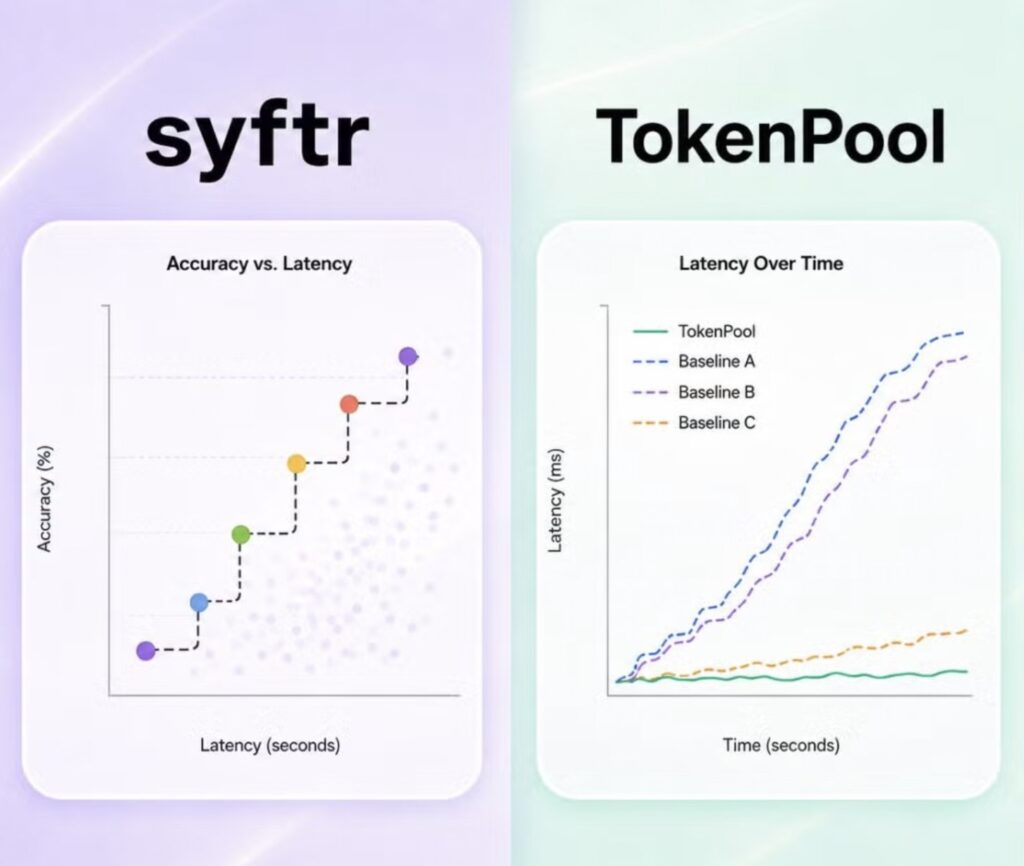
syftr searches that house as an alternative of guessing. It makes use of multi-objective Bayesian optimization to seek out Pareto-optimal flows: the configurations the place accuracy can’t enhance with out paying extra, and price can’t drop with out shedding accuracy. A site-specific early-stopping mechanism prunes clearly suboptimal candidates earlier than they burn via an analysis price range, reducing search compute by 60 to 80%. On industry-standard RAG benchmarks, it identifies workflows that lower value by as much as 13 occasions with solely marginal accuracy trade-offs.
syftr doesn’t change judgment. It provides a data-driven strategy to navigate a design house too giant to motive about by hand, looking throughout 10 proprietary and open-source LLMs, 13 embedding fashions, 4 immediate methods, three retrievers, and 4 textual content splitters, and it produces production-ready pipeline code on the finish.
pip set up git+https://github.com/datarobot/syftr.gitToken Pool: serve each tenant with out ravenous those that matter
A well-designed agent with sharp runtime reasoning nonetheless has to run someplace, often alongside everybody else’s. Multi-tenant inference hits a wall right here. Devoted endpoints strand GPU capability on idle fashions. Charge limits deal with each token as equal, though one request can value an order of magnitude extra GPU time than one other. Neither strategy lets idle capability be borrowed, and each crumble beneath the bursts that characterize actual inference visitors. The acquainted outcome: one staff’s batch job floods the endpoint, and everybody’s manufacturing latency spikes.
Token Pool fixes this on the API gateway, with out touching the inference runtime beneath. It expresses capability in inference-native models, token throughput, KV cache, and concurrency, reasonably than machine or pod counts. Tenants maintain entitlements to a share of a pool, and repair courses (devoted, assured, elastic, spot, and preemptible) set the safety ordering throughout rivalry. A debt-based equity mechanism provides briefly throttled workloads compensatory precedence later, so no tenant is starved and none monopolizes the pool. It runs as a Kubernetes-native layer above vLLM or TensorRT-LLM.
In overload testing, Token Pool held sub-1.2 second P99 time-to-first-token for assured workloads by selectively throttling spot visitors, whereas a baseline with no admission management degraded previous 19 seconds throughout each workload. For anybody liable for consumption-based economics or API governance, that is the lacking primitive: capability expressed in models that match what inference truly prices.
kubectl apply -f examples/sample-tokenpool.yaml
kubectl apply -f examples/sample-entitlement.yaml
What’s subsequent: closing the loop
These shipped initiatives function as separate hyperlinks immediately. Design-time search runs as soon as. Runtime reasoning runs blind to how the serving layer is performing. The serving layer enforces coverage with out feeding something again upstream. The workflow syftr discovered final quarter isn’t essentially optimum towards this month’s visitors, fashions, and costs.
The subsequent open-source undertaking connects manufacturing telemetry, the actual value, latency, and high quality alerts coming off the serving layer, again to the optimization layer, so workflows get re-evaluated towards manufacturing actuality as an alternative of a single offline benchmark. It’s nonetheless in evaluate, so it isn’t named but, but it surely’s the pure fourth stage after design, motive, and serve.
Get began
- Construct: set up syftr with
pip set up git+https://github.com/datarobot/syftr.gitand run the starter search - Construct: rise up Token Pool towards a neighborhood Sort cluster, no GPU required
A hands-on information for every follows subsequent on this collection: working a primary syftr search and studying the Pareto frontier, and standing up Token Pool to guard a manufacturing workload from a loud neighbor. Begin with whichever stage of the lifecycle is hurting most.