

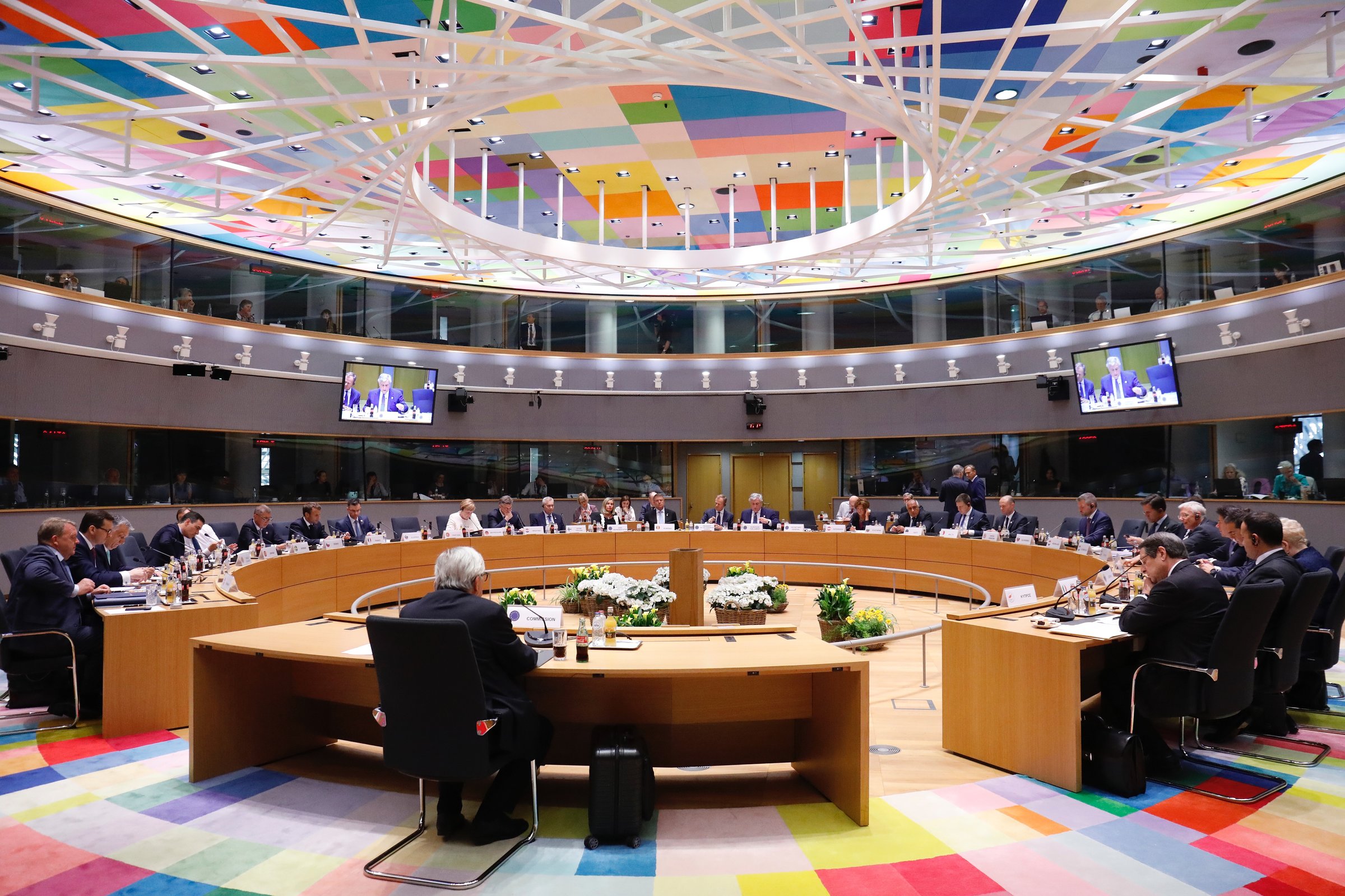
These hoping that EU leaders may strike a extra combative place in opposition to China at subsequent week’s summit in Brussels are going to be dissatisfied.
June had been billed, by some EU official factors, as a turning level in relations, with two main summits – G7 and European Council – and a collection of conferences between EU and Chinese language prime commerce officers.
The European Fee desires member states to assist an ‘overcapacity instrument’ that will forestall China from intentionally over-producing metal and a raft of different merchandise to depress costs and bankrupt European rivals.
The EU’s yawning commerce deficit with China poses a long-term, systemic risk to the bloc’s financial system that far outweighs the risks from US president Donald Trump’s tariff threats.
On Tuesday (9 June), Beijing’s commerce vice-minister, Ling Ji, was due to satisfy with new EU commerce director Ditte Juul Jorgensen in Brussels.
Juul Jorgensen has changed Sabine Weyand, who has been dispatched to the Siberia of EU officialdom – a put up on the European College in Florence – after clashing with the fee over the legality of its commerce take care of Trump.
But the draft EU Council conclusions that are circulating amongst reporters – a model of which might be issued after the summit – don’t make a single point out of China.
As a substitute, they report that EU leaders held “a strategic debate on the problem of worldwide macroeconomic imbalances.”
Leaders additionally referred to as for “decisive progress… on fostering Europe’s industrial renewal and innovation and decreasing dependencies, and on funding.”
That implies that Beijing’s lobbying and continued refusal to interact with the EU’s critique of its industrial over-supply has paid off. The controversy might be kicked down to an EU summit in October.
Clues lie in a paper signed by Spain, Italy, the Netherlands, France and Lithuania in late Could, which acknowledged that the EU wanted to take a more durable stance to “systemic and structural industrial overcapacity” – phrases usually taken as shorthand for Beijing.
Germany, whose personal financial system is more and more reliant on Chinese language inputs however whose commerce deficit with China is about to clear €100bn this yr, was not among the many signatories.
For its half, Spain, which has acquired billions of euros of Chinese language funding in digital and vitality infrastructure tasks, later withdrew its signature.
That factors to Beijing’s astute funding throughout plenty of EU economies which have created exactly the “dependencies” that EU leaders need to cut back.
And it’s not simply throughout the EU. Fee officers are more and more apprehensive about Morocco, which has been the recipient of greater than $6bn (€5.2bn) of Chinese language funding in electrical car manufacturing. The result’s that Morocco overtook South Africa final yr as Africa’s greatest carmaker.
EU commerce commissioner Maroš Šefčovič, for his half, has warned that Morocco’s contribution to Chinese language industrial over provide is a “huge, huge problem” for the bloc’s financial system.
He added that the EU wanted a particular instrument to pressure corporations to diversify their suppliers and deal with over-reliance on China.
There are indicators that German attitudes are altering.
“Both we struggle again, or China will cripple elements of our trade”, Manfred Weber, the German chief of the centre-right ‘EPP’ group within the European Parliament, advised the German press final weekend.
Weber, whose Christian Social Union is allied to the most important social gathering within the Berlin authorities, added that the EU wanted to implement powerful commerce coverage devices “decisively and with out hesitation”.
However that’s unlikely to be subsequent week.

