


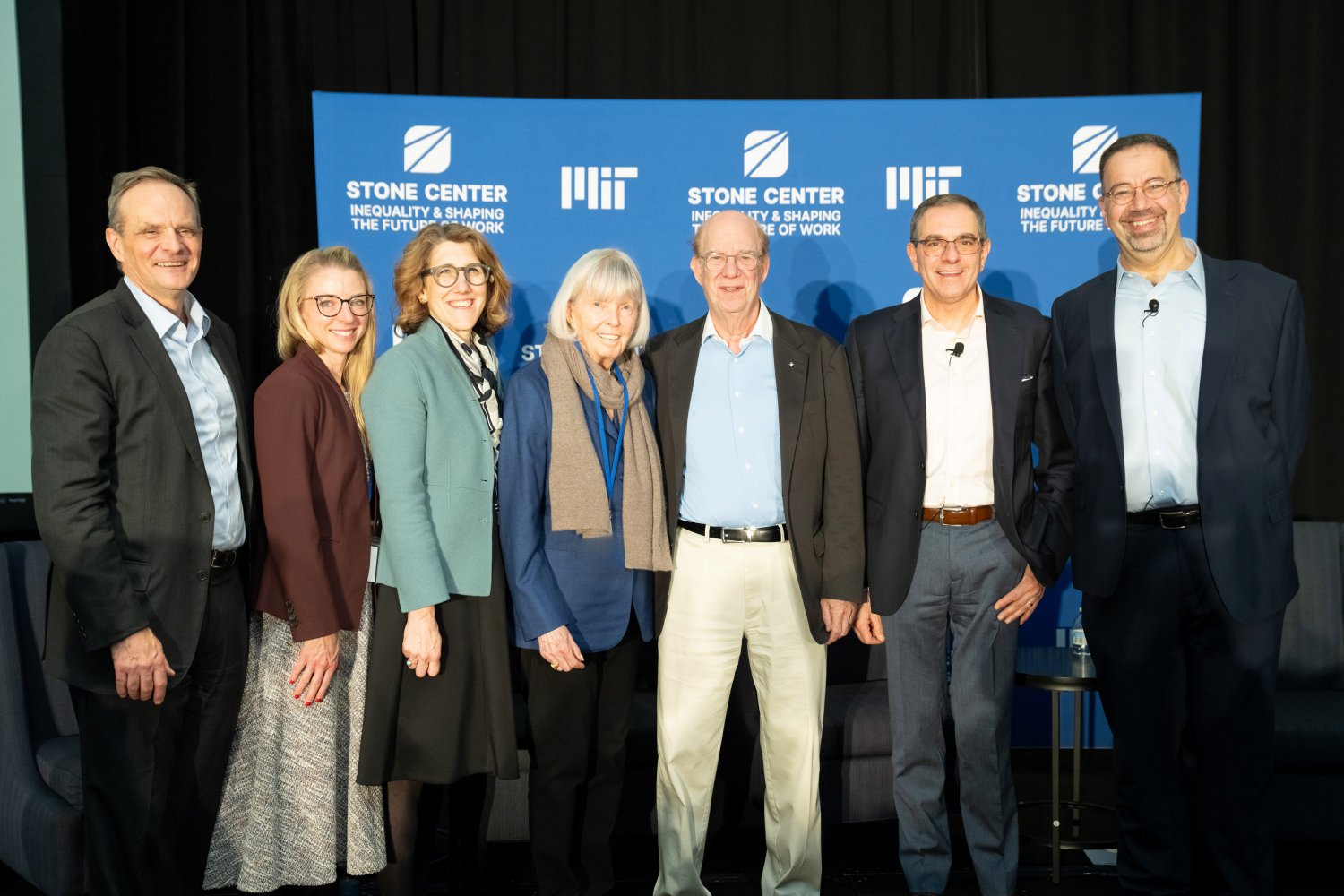
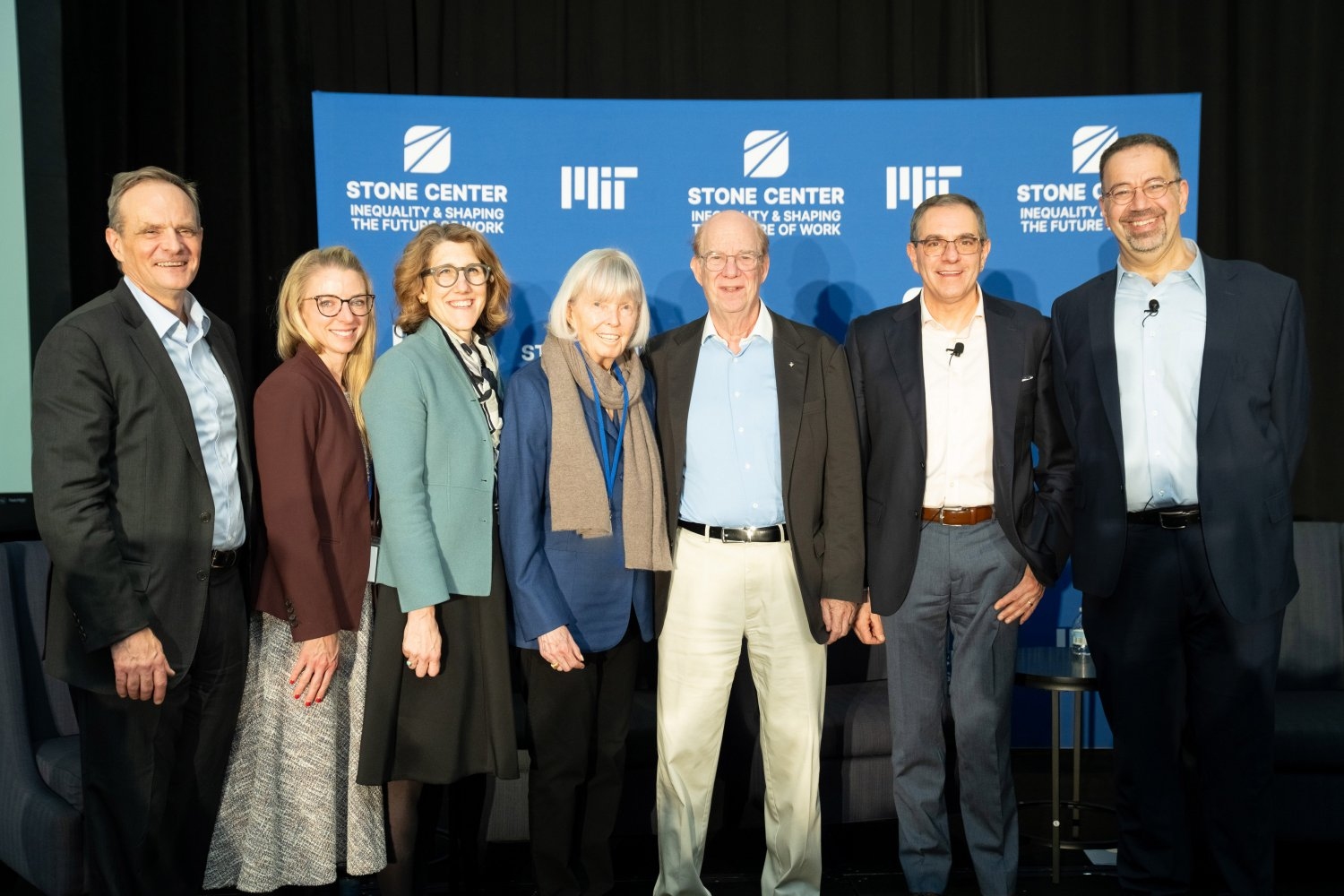
The James M. and Cathleen D. Stone Heart on Inequality and Shaping the Way forward for Work formally launched on Nov. 3, 2025, bringing collectively students, policymakers, and practitioners to discover important questions on financial alternative, know-how, and democracy.
Co-directed by MIT professors Daron Acemoglu, David Autor, and Simon Johnson, the brand new Stone Heart analyzes the forces that contribute to rising revenue and wealth inequality via the erosion of job high quality and labor market alternatives for employees with no school diploma. The middle identifies modern methods to maneuver the financial system onto a extra equitable trajectory.
MIT Provost Anantha Chandrakasan opened the launch occasion by emphasizing the urgency and significance of the middle’s mission. “As synthetic intelligence instruments turn into extra highly effective, and as they’re deployed extra broadly,” he stated, “we might want to attempt to make sure that folks from all types of backgrounds can discover alternative within the financial system.”
Listed here are among the key takeaways from individuals within the afternoon’s discussions on wealth inequality, liberalism, and pro-worker AI.
Wealth inequality is pushed by non-public enterprise and public coverage
Owen Zidar of Princeton College burdened that house owners of companies like automotive dealerships, building companies, and franchises make up a good portion of the highest 1 %. “For each public firm CEO that will get plenty of consideration,” he defined, “there are a thousand non-public enterprise house owners who’ve not less than $25 million in wealth.” These enterprise house owners have outsized political affect via overrepresentation, lobbying, and donations.
Atif Mian of Princeton College linked excessive inequality to the U.S. debt disaster, arguing that large financial savings on the high aren’t being channeled into productive funding. As an alternative, falling rates of interest push the federal government to run more and more giant fiscal deficits.
To mitigate wealth inequality, audio system highlighted coverage proposals together with rolling again the 20 % deduction for personal enterprise house owners and growing taxes on wealth.
Nevertheless, insurance policies should be fastidiously designed. Antoinette Schoar of the MIT Sloan Faculty of Administration defined how mortgage subsidy insurance policies after the 2008 monetary disaster truly worsened inequality by disadvantaging poorer potential householders.
Governments should present primary public items and financial safety
Marc Dunkelman of the Watson Faculty of Worldwide and Public Affairs at Brown College recognized extreme purple tape as a key drawback for contemporary liberal democracy. “We will’t construct high-speed rail. You may’t construct sufficient housing,” he defined. “That spurs strange individuals who need authorities to work into the populist camp. We did this to ourselves.”
Josh Cohen of Apple College/the College of California at Berkeley emphasised that liberalism should ship shared prosperity and truthful alternatives, not simply defend particular person freedoms. When folks lack financial safety, they might flip to leaders who abandon liberal ideas altogether.
Liberal democracy must adapt whereas preserving its core values
Helena Rosenblatt Dhar of the Metropolis College of New York Graduate Heart famous that liberalism and democracy haven’t all the time been allies. Traditionally, “civil equality was essential, however not political equality,” she stated. “Liberals have been very cautious of the plenty.”
Audio system emphasised that liberalism’s problem immediately is sustaining its commitments to limiting authoritarian energy and defending elementary freedoms, whereas addressing its failures.
Doing so, in Dunkelman’s view, would imply working to “get rid of the sowing [of] the seeds of populism by making authorities correctly steadiness particular person rights and the desire of the numerous.”
Folks-centric politics requires regulating social media
In his keynote on the launch, U.S. Consultant Jake Auchincloss (Massachusetts 4th District) linked these notions of presidency effectiveness and public belief to the affect of know-how. He emphasised the necessity to regulate social media platforms.
“For my part, media is upstream of tradition, which is upstream of politics,” he stated. “If we wish a greater tradition, and positively if we wish a greater politics, we’d like a greater media.”
Auchincloss proposed that regulation ought to embrace holding social media corporations chargeable for content material and banning focused promoting to minors.
He additionally echoed the urgency and significance of the middle’s analysis agenda, significantly to grasp whether or not AI will increase or exchange labor.
“My bias has all the time been: Expertise creates extra jobs,” he stated. “Perhaps it’s totally different this time. Perhaps I’m fallacious.”
Augmentation is essential to pro-worker AI — however it could require different AI architectures
Stone Heart co-director Daron Acemoglu argued that increasing what people can do, moderately than automating their duties, is important for attaining pro-worker AI.
Nevertheless, Acemoglu cautioned that this received’t occur by itself, noting that the enterprise fashions of tech corporations and their concentrate on synthetic normal intelligence aren’t aligned with a pro-worker imaginative and prescient for AI. This imaginative and prescient could require public funding in different AI architectures targeted on “domain-specific, dependable data.”
Ethan Mollick of the Wharton Faculty of the College of Pennsylvania famous that AI labs are explicitly attempting to “exchange folks at every part” and are “completely satisfied that they’ll do that within the very close to time period.”
In the meantime, corporations have “no mannequin for AI adoption,” Mollick defined. “There may be absolute confusion.” Even so, “there’s sufficient cash at stake [that] the machine retains shifting ahead,” underscoring the urgency of intervention.
In a glimpse of what such intervention might appear to be, Zana Buçinca of Microsoft shared analysis findings that accounting for employees’ values and cognition in AI design can allow higher complementarity.
“The influence of AI on human work just isn’t future,” she emphasised. “It’s design.”

