


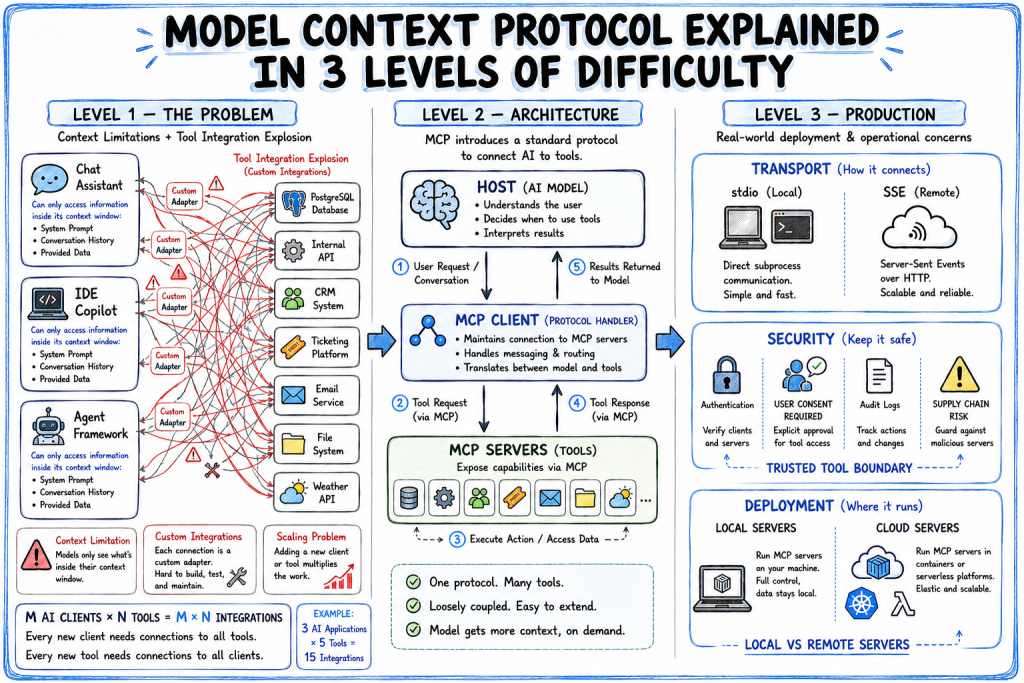
On this article, you’ll learn the way the Mannequin Context Protocol (MCP) standardizes the best way AI functions hook up with exterior instruments and information sources, damaged down throughout three ranges of depth.
Matters we’ll cowl embody:
- Why connecting fashions to exterior techniques and not using a shared normal creates an integration drawback that grows with each new shopper or device.
- How the host, shopper, and server work collectively, and what occurs when a mannequin’s request flows by way of an MCP server.
- The transport choices, safety dangers, and deployment decisions that matter as soon as an MCP server is working in manufacturing.
Introduction
Each massive language mannequin has the identical limitation baked in: its data stops at coaching time. Ask it a couple of file in your machine, a row in your database, or an electronic mail that got here on this morning, and it both halts or guesses. The mannequin is sealed off from the techniques your utility really runs on, and bridging that hole falls solely on the developer.
The standard method is to write customized integrations — a operate right here, a device definition there — that pipe exterior information into the context window. That works at a small scale. However when you’re connecting a number of fashions to a number of providers, you find yourself sustaining a matrix of one-off adapters, every with its personal auth logic, schema assumptions, and failure modes. Including a brand new mannequin or a brand new service means remodeling that entire matrix once more.
The MCP is an open normal, launched by Anthropic, that offers this drawback a cleaner form. As a substitute of each AI utility constructing its personal connectors to each exterior system, each side implement a shared protocol. A service exposes itself as an MCP server as soon as, and any MCP-compatible shopper can use it.
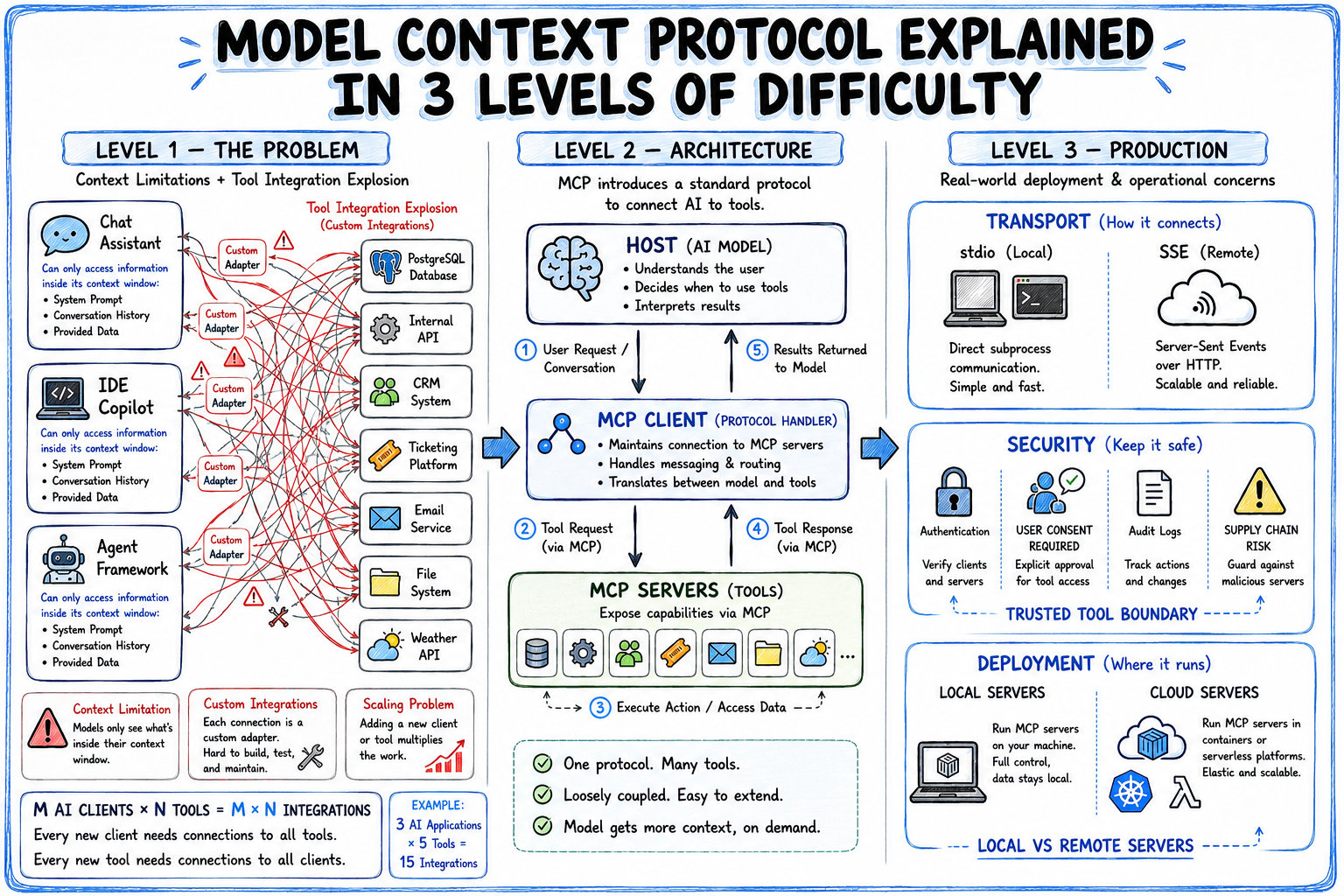
This text walks by way of how MCP works at three ranges: why the issue exists and what MCP’s core concept is, how the structure matches collectively and what a request seems to be like, and at last the transport, safety, and deployment selections that matter whenever you take it to manufacturing.
Stage 1: Why MCP Issues
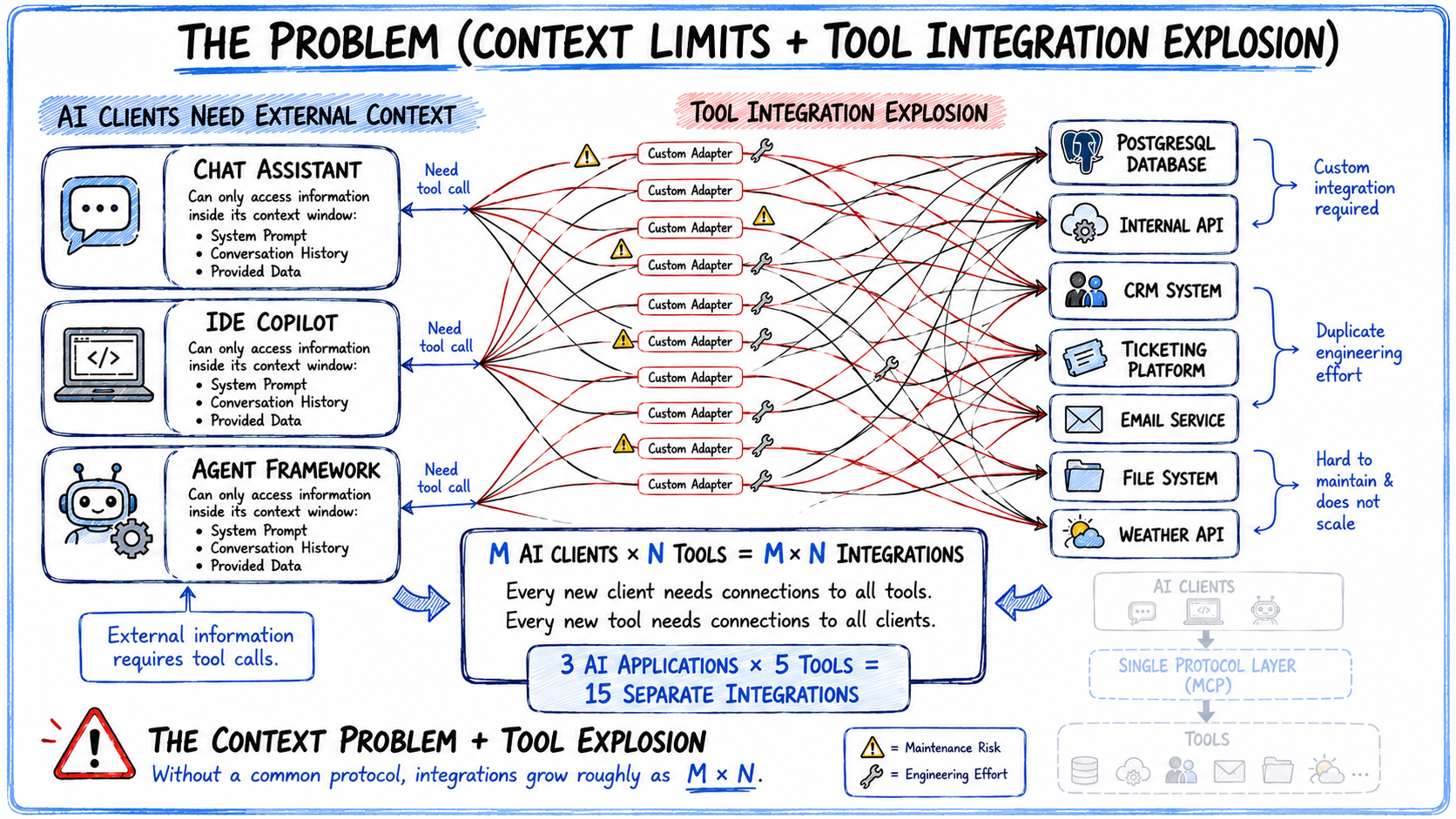
A mannequin can solely work with info out there in its context window: the system immediate, dialog historical past, and any extra information offered through the interplay. Accessing info outdoors that context requires exterior instruments.
Most AI techniques help device calling. When a mannequin requests a device, the applying executes the request, retrieves the required information, and returns the consequence to the mannequin. This enables fashions to work together with databases, APIs, file techniques, and different exterior techniques.
Because the variety of AI functions and exterior instruments grows, integration complexity will increase. Think about:
- M AI shoppers (chat functions, IDE assistants, agent frameworks, mannequin suppliers)
- N instruments and information sources (databases, APIs, inside providers, SaaS platforms)
And not using a shared normal, every shopper sometimes requires its personal integration with every device. The variety of client-tool adapters can due to this fact develop as M × N.
For instance, if three AI functions want entry to 5 inside instruments, you might find yourself constructing and sustaining fifteen separate integrations. Including a brand new device requires integrating it with each shopper. Including a brand new shopper requires integrating it with each device.
The Downside That MCP Solves
MCP gives a regular method for AI functions and exterior techniques to speak.
AI functions implement the MCP shopper specification. Instruments and information sources expose capabilities by way of MCP servers. As a result of each side observe the identical protocol, an MCP server can be utilized by any suitable MCP shopper with out requiring a customized integration for that particular shopper.
As a substitute of constructing a separate adapter for each client-tool pair, every shopper implements the MCP protocol as soon as and every device implements it as soon as. The combination floor shifts from roughly M × N customized adapters to M + N protocol implementations.
The sensible result’s a extra composable ecosystem. An MCP server that exposes a PostgreSQL database, inside API, or ticketing system can be utilized by a number of assistants, IDEs, and agent frameworks by way of the identical protocol relatively than by way of separate integrations for every platform.
Stage 2: MCP Structure and How a Request Flows
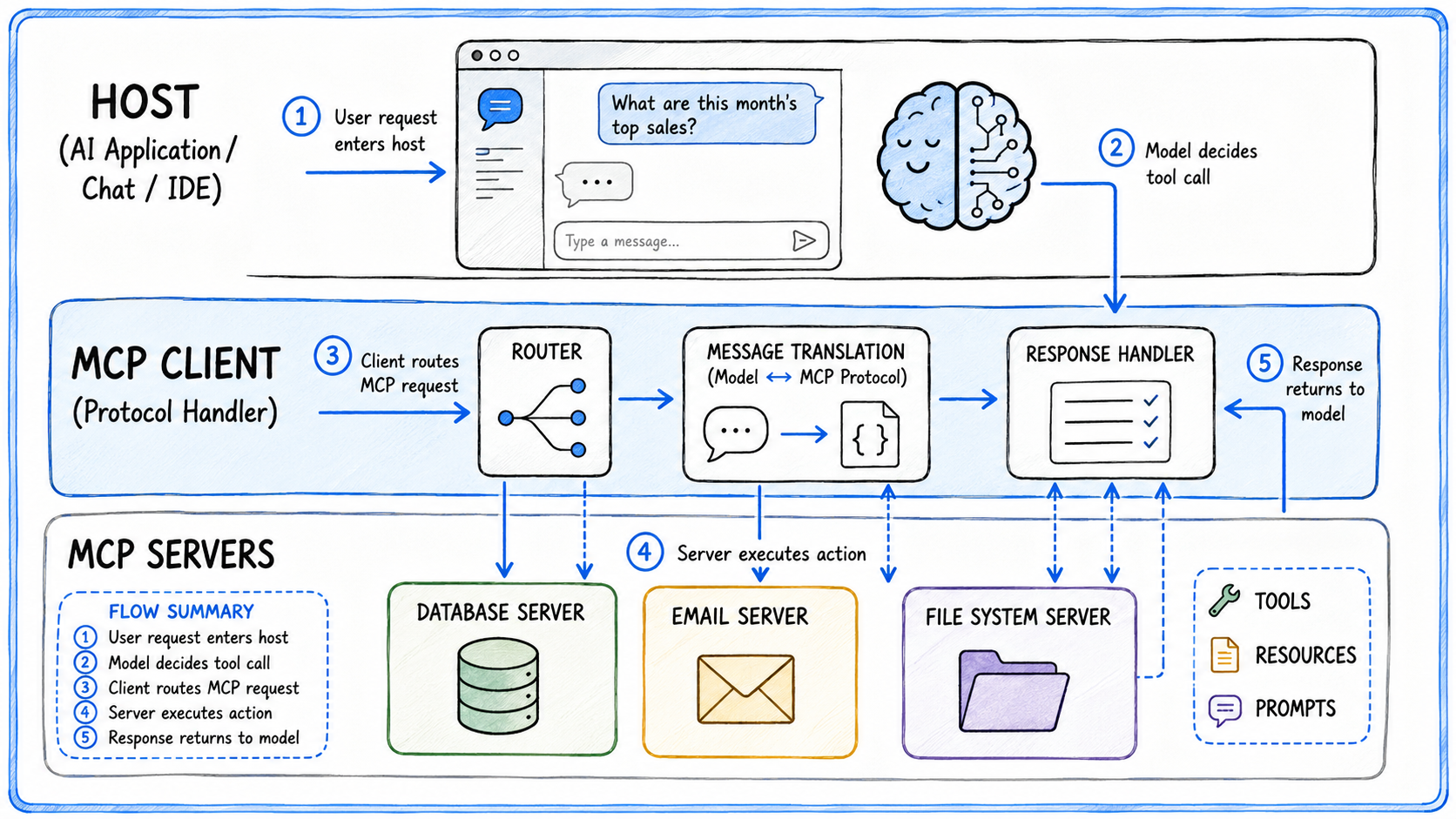
MCP interactions contain three components: the host, the shopper, and the server.
The Host
The host is the applying the consumer really talks to. This could be a chat interface, an AI-powered IDE, or a customized agent. It incorporates the language mannequin and drives the dialog. When the mannequin decides it wants to achieve out to an exterior system, that call originates right here.
The Consumer
The shopper sits contained in the host and handles protocol mechanics. It maintains a registry of obtainable MCP servers, interprets the mannequin’s requests into correctly formatted MCP calls, dispatches them to the appropriate server, and converts responses again into one thing the mannequin can use. From the mannequin’s perspective, it simply asks for issues. The shopper handles the plumbing.
The Server
The server is your bridge to an exterior system. It registers its capabilities — what instruments it gives, what information it may present — and responds to requests from shoppers. A server sitting in entrance of a database takes a structured device name from the shopper, runs the suitable question securely, and returns leads to a format the mannequin can work with. The server owns all of the implementation particulars of that system; the shopper and mannequin solely see the MCP interface.
MCP Host, Purchasers, and Server
Tracing a Request
Say a consumer tells an AI assistant: “Seize the Q2 income numbers from the database and put collectively a abstract for the workforce.”
The mannequin sees it wants two issues it may’t do by itself. The shopper checks its registered servers and finds a database_query device and an email_draft device on two separate MCP servers.
The mannequin calls database_query with the related parameters. The server runs the question, codecs the outcomes, and sends them again by way of the shopper to the mannequin. Now working with actual numbers, the mannequin calls email_draft — recipient record, content material, topic. The e-mail server handles the remainder, confirms success, and the mannequin tells the consumer it’s achieved.
Neither server knew something in regards to the different. The mannequin coordinated the steps. The shopper dealt with protocol translation the complete time. The developer didn’t write any glue code between the mannequin and both system.
Instruments, Assets, and Prompts
MCP servers expose three sorts of capabilities:
- Instruments are callable capabilities. The mannequin invokes them to take motion or retrieve computed outcomes.
- Assets are readable information the mannequin can pull in as context: information, data, paperwork.
- Prompts are reusable templates the server gives, helpful for standardizing how your group desires the mannequin to method sure duties.
The excellence between instruments and assets issues operationally. Studying a useful resource is a passive, comparatively low-risk operation. Calling a device that writes to a manufacturing system is a distinct class of motion solely. Conserving them separate helps you to apply totally different authorization insurance policies to every.
Stage 3: Transport, Safety, and The place MCP Runs
As soon as the structure is smart, the remaining questions are those that resolve whether or not an MCP deployment holds up outdoors a demo: how messages bodily transfer between shopper and server, what can go mistaken when a server is untrustworthy, and the place the server itself ought to run.
How Consumer and Server Truly Discuss
MCP splits communication into two layers, and it’s value understanding them:
- The information layer is the precise protocol: it’s JSON-RPC 2.0 beneath, and it defines the connection lifecycle plus the primitives we mentioned earlier.
- The transport layer is simply the pipe these messages journey by way of to get from shopper to server.
Two servers exposing equivalent instruments can run over utterly totally different transports with out the information layer caring in any respect; that separation is what lets MCP swap one for the opposite with out touching how any device behaves.
MCP presently defines two transports:
stdiois for native servers. The shopper launches the server as a subprocess and the 2 discuss over normal enter and output. It’s easy, quick, wants no community setup, and retains every thing on one machine. This can be a good match for IDE plugins, native file entry, and something working alongside the host.- Streamable HTTP is for distant servers. The shopper and server alternate JSON-RPC messages over a single HTTP endpoint that helps each POST and GET, with the server optionally utilizing Server-Despatched Occasions to stream a number of messages again, which is beneficial for long-running calls and server-initiated notifications.
The Belief Downside and Safety Constraints
MCP offers a mannequin actual attain into databases, inboxes, or something a device touches. Many of the precise danger comes from authentication plumbing, which is what the MCP safety finest practices web page outlines:
- A proxy server that reuses one mounted shopper ID and trusts a leftover browser cookie as an alternative of checking consent per shopper can find yourself forwarding a stolen authorization code.
- Forwarding a shopper’s token to a downstream service with out confirming it was really issued for you breaks audit trails and fee limits.
- A guessable or improperly-bound session ID lets anybody who finds it act as that consumer.
There’s a separate publicity drawback too: a malicious server can hand a shopper URLs pointing at inside IPs or cloud metadata endpoints throughout routine OAuth discovery, and something you run regionally executes with your individual privileges, so an unreviewed startup command can attain your filesystem straight. The repair in each circumstances is to validate tokens that had been issued for you, bind periods to actual identification, grant slender scopes, and sandbox native servers relatively than trusting them by default.
The MCP overview from Google suggests the next: Get consumer consent earlier than an agent acts or shares information, restrict what a server can see, don’t belief a device’s self-description except the server is vetted, sanitize what comes again earlier than it’s logged or proven, and maintain auditing device exercise to catch misuse.
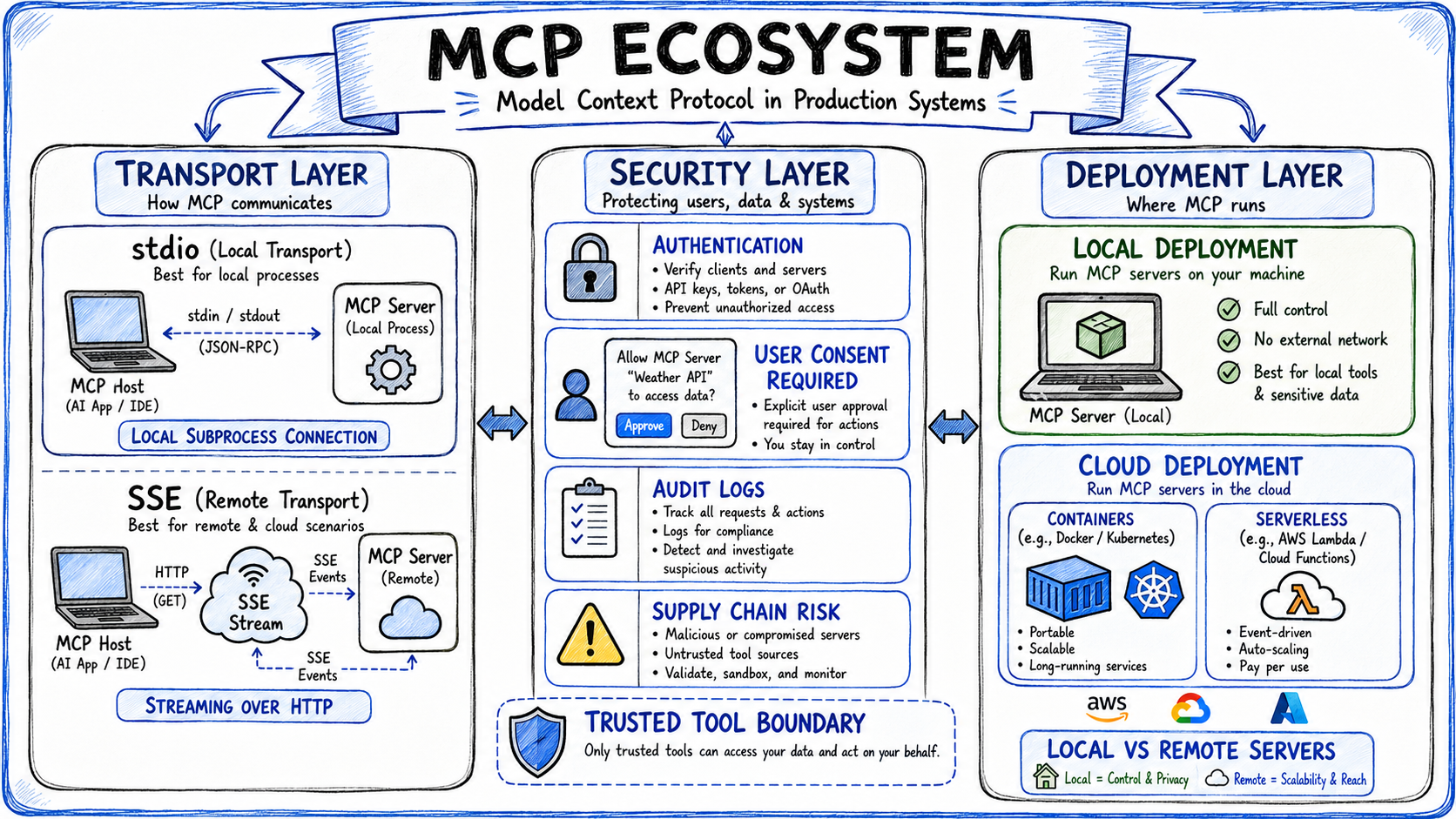
Transport, Safety, and The place MCP Runs
Selecting The place MCP Servers Run
The local-versus-remote cut up that shapes transport selection additionally shapes the way you deploy.
- Native servers run as subprocesses on the identical machine because the host. That is quick and personal, which fits delicate information or a private dev setup.
- Distant servers run independently and might serve many purchasers directly. They require extra to function, however they scale and could be maintained individually from no matter utility is asking them.
On the internet hosting facet, the identical supply notes that serverless platforms like Cloud Run swimsuit easy, stateless instruments that ought to scale all the way down to zero between calls, whereas one thing like a managed Kubernetes surroundings matches stateful or high-throughput servers that want finer management. Whether or not that infrastructure is managed for you or run by yourself {hardware} principally comes all the way down to compliance and data-residency constraints. Managed internet hosting handles uptime and scaling, whereas self-hosting trades that comfort for full management.
A Rising Ecosystem to Construct On
MCP is open supply, with SDKs masking the main languages, and a steadily rising set of ready-made MCP servers for frequent techniques like GitHub, Slack, and Postgres. So that you typically don’t must construct a connector from scratch. Consumer help has adopted the identical path: IDEs like Visible Studio Code help MCP natively alongside Claude and different assistants.
Wrapping Up
MCP solves an actual integration drawback that anybody constructing AI-powered functions runs into shortly: connecting fashions to exterior techniques is repetitive, fragile, and doesn’t compose properly and not using a normal. The protocol offers you that normal: a clear separation between the AI utility and the exterior functionality, with a well-defined interface between them.
- On the conceptual degree, it gives a constant method to entry exterior info and capabilities.
- On the architectural degree, it defines how hosts, shoppers, and servers work collectively to attach fashions with instruments, assets, and prompts.
- On the operational degree, it gives transport choices and safety patterns that make real-world deployments sensible and scalable.
As adoption grows, MCP is changing into a standard basis for constructing AI techniques that may work together reliably with the software program and information they rely on.
Listed below are just a few assets value bookmarking:
Completely satisfied studying!

